Suelle Stewart Creative

Content Marketing Solutions for Small Business

  • Facebook
  • LinkedIn
  • RSS
  • Twitter
Privacy & Cookies: This site uses cookies. By continuing to use this website, you agree to their use.
To find out more, including how to control cookies, see here: Cookie Policy
  • Home
  • Promotions
    • Are You a Chamber Member?
  • Blog
  • About
  • Services
    • Quick Start
    • Monthly Email Marketing
  • Contact
Home Archives for 2016

Archives for 2016

August 23, 2016 By Suelle Leave a Comment

Allow Me To Introduce Myself…

If you attend networking events, how much attention do you give to your introduction? Often called an elevator speech, it is meant to be a brief summary of who you are and what you do in the time it takes ride an elevator (no elevator actually required). I know in the various networking groups I attend, a brief amount of time is allotted for members to introduce themselves; forty-five seconds to one minute is all we really need. Surprisingly, most people don’t have a well-polished, rehearsed introduction prepared. I know I need to make my own introduction better.

A great introduction takes time to prepare.

Why spend time to create an introduction? It is the first content you share with people to tell them who you are and what you do. You want to draw attention to yourself. You want to be memorable and informative.

The Basic Elements

Your introduction is a concise description of:

  • Your name
  • Your company
  • Your product or service

Sounds easy, right?

Make a Plan

Now that you know what your basic elements are, it’s time to build upon them. We were all taught to write with an opening, body and conclusion in elementary school. This guide still holds true today.

Opening
  • Introduce yourself.
    • TIP: Stand up so people can hear you.
  • Tells us your product/profession or service.
  • Keep it simple. Unless you are in a group of peers who speak the same “language”, try to eliminate any confusing jargon.
Body
  • Include 2 – 3 points about what is is you do.
  • Keep those points relevant. It is easy to drift off track and ramble.
  • Try to include some reason people should care about your product/service or what makes you stand out from the rest.
  • Write different versions to fit different networking events.
Conclusion
  • Include a call-to-action. It’s amazing how many people don’t do this. It’s as simple as, “If you are ready to try product X, call me to learn more.”
  • Tell people how they can contact you. You do not need to go into details so much as tell people to pick up your business card. Which prompts this reminder: don’t forget to bring business cards.
  • Leave a positive, lasting impression. You want to be remembered when you meet people outside of your network group.
  • Be ready to expand on your introduction if asked.
Tips to Consider
  • Try to eliminate crutch words. These are all of the filler words we tend to use when we speak. Examples: um, ah, er, you know, like or, the repetition of a word. Fillers words are distracting and they make it sound as if you not confident about what you do.
  • Be aware of your body language. This communicates more than words. Try to appear open and welcoming.
  • Vocal variety adds spice to your introduction. We all remember the speaker with the monotone voice but we don’t remember what was said.
  • Be courteous of time. It’s surprising how fast one minute flies by. If you prepare and practice, you can convey your message within the allotted time. Remember, there are others who are given the same amount of time to give their introduction.
  • Practice, practice, practice.

Now that you have an outline, you can create a powerful and memorable introduction. I look forward to hearing yours!


Filed Under: Content

July 27, 2016 By Suelle Leave a Comment

Are you compliant?

The following blog is for information only. I am not a lawyer nor am I an expert regarding CASL legislation. Please seek legal advice if your organization has questions about CASL.

Spam Definition Button Shows Unwanted And Malicious Email

Do you remember June of 2014? You may have received a sudden influx of emails requesting you click a link and provide express consent to remain on an email list. The flurry of activity was a result of CASL – Canada’s Anti-Spam Legislation – which came into effect on July 1, 2014. Basically, the law is meant to protect us from spam and malware (the malware legislation came into effect on January 15, 2015).

Why do I bring this up now? The three year grace period to ensure your email practices are compliant ends on July 1, 2017. Now is a good time to review how your gather email consent.

Implied Consent vs. Express Consent

First, let’s define Consent. In this instance, consent is when you have permission from a contact to send them Commercial  Electronic Messages (CEMs); in plain language, an email. If you are sending an email encouraging a business transaction, it would be deemed a CEM.

business card exchange no textImplied Consent is consent that is inferred based on actions, such as having an existing business relationship. Prior to July 2014, most people exchanged businesses cards and added the information to a contact list without any regard of whether the contact wanted to receive emails from you. Implied consent can come from other sources such as making a purchase, becoming a donor or, entering into a written or electronic contract. This consent is valid for two years. You will need to renew the implied consent. The easiest thing to do is ask if you have express consent from the outset and jot the date of consent on the business card or sign-up sheet.

contacts

Express Consent is clear permission from a contact that you may send them a CEM. This permission may have be obtained electronically, orally or in writing. Once you have express consent, it does not expire. There must be a mechanism with which a subscriber can unsubscribe at any time.

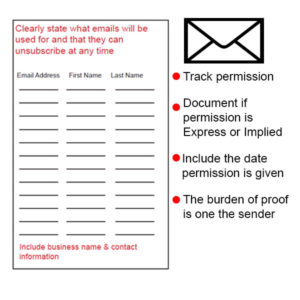
The most important component to express consent is the onus is on you to prove you have acquired permission to send a CEM to a contact. 

Off-line considerationsFB-CASL-reminder-for-SMall-Business-Week-2014

Not all email addresses are gathered on-line. Emails are collected at a point-of-sale, fundraisers, local markets, conferences and, networking events. If you use a sign-up sheet at an event, be sure your sheet clearly states that the subscriber is granting express permission to receive emails from you and that they can unsubscribe at any time. Your sign-up sheet must include your business name and relevant contact information.

You may include:

  • the types of emails – sales vs. informational
  • the frequency – daily, weekly, monthly etc.

Review Your Collection Methods

Now is a good time to review your lists. Most third-party email platforms should have provided the mechanisms with which to track activity on your contact lists. Whether you are collecting email addresses on-line or off-line, make sure you have the following elements:

  • Does your sign-up list have clear and obvious language asking for permission to be contacted in the future?
  • Does your sign-up sheet clearly identify you, your business or organization? This must include a valid mailing address and contact information.
  • Do you have a process with which to document consent?
  • Does your sign-up sheet indicate to subscribers that is a mechanism with which they can unsubscribe?

Don’t be Offended

People will unsubscribe from your newsletter. Don’t take this personally. People receive a lot of email in the run of a day and unsubscribing can reduce the clutter in their inbox. Your challenge is to provide educational, entertaining and engaging content your subscribers can use. Inform; don’t sell!

Who’s in Charge?

In case you are wondering who is responsible for enforcing the legislation, the oversight of CASL falls under the following governmental banners:

  • Industry Canada; Spectrum
  • Information Technologies and Telecommunications Sector (SITT)
  • Canada’s Office of Consumer Affairs (OCA).

I encourage you to visit fightspam.gc.ca to learn more.

Contact me if you would like a CASL Marketing Review.

Filed Under: Content

April 25, 2016 By Suelle Leave a Comment

In the beginning…

Have you given any thought to your origin story?

What a wonderful beginning

I was sitting in Kal Tire recently waiting for my tires to be changed. I have a tendency to scan walls of a place if I have to wait.  On the wall next to me hung a photo of the founder, Tom Foord, and a brief story about how Kal Tire came to be. Kal Tire was founded in 1953 in Vernon, BC. It was named after Kalamalka Lake, there are more than 250 Kal Tires in Canada and it’s head office is still in Vernon BC. The brief description tells the story of a man who started a small business, grew it to a national brand and, yet, remains grounded in its local roots.

You all know the almost-mythical stories of tech giants who started in a garage or a basement, or the humble beginning of someone who just wanted to make something better [ Sara Blakely, the founder of Spanx. comes to mind]. It’s the story that compels you. Some of you use a story as a road map to your own journey. You say to yourself, “If they can do it, so can I”.

Why should you tell your story?

You can discover most origin stories on the “About” page of a website. Your origin story tells your audience who you are and what you do. It helps you to build trust with your audience. When you share who you are and where you come from, you become a person and not just a business. Your audience is more likely to connect with you. You become a reference point. You understand your audience’s struggle because you have experienced the same struggle and, you know how to help them. Above all else, be honest and trust-worthy. Once you have your story, you can adjust it and use it elsewhere; it’s your elevator speech at a networking event, it’s your boilerplate(see definition), and it’s your mission statement and values upon which you have built your business.

What to Include in Your Origin Storyspark

Your origin story does not need to be epic. In most instances, your origin began with the seed of an idea or an “aha” moment. Just take your audience on your journey and tell them what inspired you to do what it is you do.

  •  Tell them about the challenges you faced.
  • Take them on the journey to overcome this challenge. Include your failures, as well as, your successes that brought you to a pivotal moment.
  • Discuss how this “moment” led to you to do or create something that can help others.
  • Share your passion and insight.

What’s My Story?

While my story is not epic, it was bold [possibly akin to a mid-life crisis]. I had a good quasi-government job but I was very bored. I was disenchanted and disengaged. I was almost finished my Diploma in Public Relations and wanted to use my new-found knowledge. I was unable to move to such a position within the organization so I sought a one elsewhere. Basically, I quit a full-time job for a volunteer position at a non-profit organization to do what I wanted to do. And, wow, what an experience. I got to create copy, reach out to the media, help craft the details of a major fund raising event , learn about the power of community through social media and, the importance of how the story drives everything. After that experience, I connected with the Duncan Cowichan Chamber of Commerce and volunteered to help with an event. From there, I joined the chamber to connect with the local business community. I attended a luncheon about email/content marketing and thought, “I can do that.”  Most people don’t have the time to put together the details of a newsletter or a blog. I knew I could help provide this service.

Sometimes, the bravest thing you can say is, “I can do that.”

Which prompts my above question? How did you get started? What was the impetus that finally moved you onto your current path? Some of you experienced an epiphany or life-changing event; others have slowly moved towards the place you are today. Whatever your story, make sure people know it.

quotes-27-091515-1680

Filed Under: Content

March 2, 2016 By Suelle Leave a Comment

Cooking Up Fresh Content

Business card template showing illustration of a chef, cook or baker holding serving pot of food done in retro style set inside hexagon.

I like to cook and bake. There is something satisfying about taking a selection of ingredients and bringing them together to create something delicious to share with others.

You can think of creating content as the same thing. You want to create something consumable and leave your audience wanting more. More importantly, you want your audience to share.

Grocery list - baking

For me, both start with a little research. What would I like to create today and share with others? Is it relevant? Is it engaging? Does it provide insight to a problem your audience may have? Once you have decided what you would like to write, it’s time to ignore the blinking cursor and just get started.

The basic rules apply:

  • Start with an idea and build upon it. We have all learned this in school. If you forgot the basics, there are many resources out to get you started.
  • Sentence structure counts. There is something off-putting about a poorly structured sentence. Spelling and punctuation also make a difference. I always keep my CP Stylebook handy.
  • Make you sentences digestible. Use jargon if it is absolutely necessary but explain what the jargon means to those who may not know.
  • Use your own voice and write using language that is easy to read and contains a little of your own personality.

Ingredients for baking (flour, egg, brown sugar, milk) with vintage cupcake's forms on old wooden table Like preparing a dish, I want my content to be fresh. I want it to reflect the present and not be some re-heated leftovers passed off as something new. The easiest way to create content is to ask what people want or need. Remember, your content should be about your audience; not you. Are there Frequently Asked Questions that can be turned into helpful content? Can the content be portioned out into a short blog series, breaking a large topic into smaller digestible posts for your audience to follow? This is where your content can work for you. Once it has a place on your website, you can share via various social media platforms and your newsletter. While you may not to ‘re-heat’ your content, you certainly can re-visit it if there are new developments to a particular topic.

dessertLike food, presentation matters. Use images to add texture to your content and to make it visually appealing. Your audience will relate an image to your message much quicker that just having text alone.  Take your camera with you and take lots of pictures. Catalog them to coincide with future blog posts. If you don’t have the right image, you can find many sites offering free images. If you copy an image, remember to include your source.

The key ingredient to remember is, ‘inform’; don’t ‘sell’. No one wants to read a hard sell message. This will keep your audience coming back for more.


Filed Under: Content

Receive tips and ideas to help you create content that will engage, educate, and entertain your audience.

Select list(s) to subscribe to


By submitting this form, you are consenting to receive marketing emails from: . You can revoke your consent to receive emails at any time by using the SafeUnsubscribe® link, found at the bottom of every email. Emails are serviced by Constant Contact

Join me on Facebook

Join me on Facebook

Blog Archives

  • March 2020
  • September 2018
  • April 2017
  • August 2016
  • July 2016
  • April 2016
  • March 2016
  • July 2015
  • June 2015
  • February 2015
  • January 2013

Search this site

Recent Posts

  • Storytelling in an Uncertain Time
  • Is Your Content Agile?
  • Emails with Benefits
  • Allow Me To Introduce Myself…
  • Are you compliant?

My Services

Email Marketing
Content Curation
Graphic Design

Contact Me

Call: 250-744-7680

Email: suelle@suellestewartcreative.com

Website Design by MAC5

SiteLock

Copyright ©2015 Suelle Stewart Creative - All rights reserved | Website Design by MAC5