Suelle Stewart Creative

Content Marketing Solutions for Small Business

  • Facebook
  • LinkedIn
  • RSS
  • Twitter
Privacy & Cookies: This site uses cookies. By continuing to use this website, you agree to their use.
To find out more, including how to control cookies, see here: Cookie Policy
  • Home
  • Promotions
    • Are You a Chamber Member?
  • Blog
  • About
  • Services
    • Quick Start
    • Monthly Email Marketing
  • Contact
Home Archives for Content

March 31, 2020 By Suelle Leave a Comment

Storytelling in an Uncertain Time

Credit: Illustration 175279563 © Buddhilakshan4 – Dreamstime.com

We are experiencing a global event that is affecting every part of our daily lives. We are inundated with continued messaging around COVID-19 and its disruptive fallout. How you respond to this ever-changing landscape is important.

Your initial storytelling will change. You want to inform your audience about how protocols affect interaction with your customers. Once that information is dispersed, it’s an opportunity to tell people you are still here and are ready to help any way you can.

What you can do

  • Connect with your audience. Tell your audience how you are addressing health concerns during this time. Let them know steps you are taking to ensure their safety. Share with them how they can support your business. Many local businesses are shifting how they deliver their service to their customers. In many cases, it literally is shifting to delivery. Local restaurateurs are using video to show take-away options and encourage you to support small business throughout the area.
  • Be clear. Clarity and the use of plain language is key. Don’t assume people know how you intend to keep them safe. People respond to clear messaging; they know where they stand when your communication is clear.
  • Be compassionate. Remind your audience about your business’ core values and how you are committed to honouring those values. Tell stories about people, including your staff, and how the COVID-19 protocols affect them. Share the stories of hope and of community support.

Credit: Photo 98852281 © Vladimir Nikulin – Dreamstime.com

A key point to remember is don’t assume everyone sees your message if you publish via one platform. Write your statement(s) as a blog and share it through whatever platforms work for you. This includes email, Facebook, Twitter, Instagram and any other platform you may use.

One caution: This is not the time overtly tie your product to a crass sales promotion. No one wants to see a “get your COVID-19 deal now”.

Who is in the best position to tell your story right now? You are.

Tell it with authenticity and compassion.

Filed Under: Content Tagged With: audience, Content, crisis, storytellng

September 25, 2018 By Suelle Leave a Comment

Is Your Content Agile?

For the past few months, Tank, the Chief Walking Officer, and I have been training in Agility. It takes time and dedication to learn how to work as a cohesive unit and we have a great deal of training before we can even step foot on to a course. The subtle finesse of guiding Tank through an agility course applies to creating content for your audience.

Learn the Language

The most difficult part of communication is learning to speak a common language. I am learning to “speak” with Tank so that we both achieve a common goal. If you communicate using technical language(assuming your audience is not privy to insider jargon), you are less likely to connect with your audience. Break down your subject matter into relatable words and ideas. For instance, scan any blog or social media post and you will notice a pattern of pop culture references used to explain complex ideas. I had an idea for a CPA to use Star Wars as a way to explain why using an accountant will save your business money. Ex: How a good financial plan would have saved $$ on the Death Star. Seriously, how do you build a second Death Star with the same fatal flaw? Sorry, I digress.

Guide Your Audience

I can’t guide Tank through a tunnel or over a jump if I don’t give him the proper cues. I am learning to break a complex task into verbal and non-verbal clues to achieve a successful outcome. The same idea works for your content. If you content is complex, provide markers to guide your audience through dense material. We all remember the simple tenet from school about the first sentence of a paragraph setting the theme for what follows. With the quick and short writing style of blogs and newsletters, you have the advantage of using subtitles(as I am doing here) as your introduction to the next idea. Don’t just write about a topic, reward your audience with valuable information. A small reward will keep your audience coming back to you for more insight and assistance. This leads in to the next section…

Be the Expert BUT Keep it Simple

To be honest, it’s been a challenge training Tank. He’s a deadly combination of smart and stubborn. He’s the reason I sought the guidance of an expert. She is helping me to shape our behaviours which, hopefully, will lead to success. When we are having trouble perfecting a task, my instructor reminds me it’s not the dog’s fault; it’s mine. She helps me to break my commands into verbal and non- verbal cues Tank will understand.

Your audience is consuming your content for the same reason; they are seeking advice from an expert. This is your opportunity to offer help and assistance to address your audience’s issues or concerns. In The Copywriter’s Handbook(Bly, Robert. New York: St. Martin’s Press, 1985, 2005), it suggests you keep your message simple. Don’t over-complicate your message using long sentences or big words. If your audience doesn’t understand the advise your impart, you are at fault. Always write with your reader in mind.

Motivate Action

In the end, my ultimate goal is to motivate Tank to successfully navigate the obstacles. I need to engage his attention and guide him to the end of the course(he’s a year and a half old Lab so this proves to be difficult some days. Lab owners can relate). Your content should do the same thing; motivate your readers and guide them to the end a.k.a. Call-to-Action. You may not motivate from the start. It takes time and commitment. It takes time to build trust. It takes time to build a relationship. As all of these elements come together, you will be surprised just how easily your content becomes more agile.

Filed Under: Content

April 28, 2017 By Suelle Leave a Comment

Emails with Benefits

Have you given any thought to using your email marketing platform for more than newsletters? Have you considered creating a loyalty program?

Why?

A loyalty program allows you to offer frequent customers rewards for their continued support for your business. It makes your customers feel special and appreciated. It helps to build your brand ambassador base and, creates trust and long-term relationships. A loyalty program also promotes customer retention. People are more likely to continue doing business with you if a continued relationship exists.

By using your email marketing platform you can created targeted rewards, which can be used as a part of your continued marketing strategy. Asking customers to join your program is the first step in building trust. When you ask them to sign up to your email list, they are providing personal data in return for benefits.

Are people likely to shop at your business because of a loyalty program? No, but what a loyalty program can do is give you access to valuable data to help target your loyal customers with offers and benefits to boost customer retention. It heightens the purchasing experience by making your customers feel special. When membership has privileges, your customers will have a sense of distinct belonging. This distinction tends to be shared with others. Instead of you inviting customers to join, your VIP customers use word-of-mouth to speak about the benefits of membership.

Examples of valuable data:

  • Spot trends in shopping behaviour.
  • Cross-sell or up-sell your products or service.
  • Create targeted marketing to personalize offers.
  • You can inform you audience of product recalls.
  • Birthdays/Anniversaries
  • Bonus to try new products

How?

First, and foremost, you will have to decide what your loyalty program will look like.

  • Will it be exclusive?
  • Will it be based on purchasing behaviours?
  • Will it be meaningful to the customer?
  • Will there be a hierarchy? E.g. bronze, silver, gold?

And the list goes on. Once you have established the goals and parameters of your program, you are ready to begin. 

  • Encourage customers to join your email list. This is your first chance to include a benefit. When someone signs up to your list make sure you send a Thank You/Welcome email with a special bonus.
  • Gather targeted information (if you can and if people are willing to share). This is easier for small businesses as they know their customers shopping habits.
  • Create targeted lists e.g. Sales, Events, Special Offers. The lists can be whatever works for your business.
  • Create a calendar and content exclusive to your loyalty program.

If you are still ensure about loyalty programs consider this; “the average Canadian is enrolled in 11.3 loyalty programs, out of which 7.3 are actively used.” (Source: The Statistics Portal)

Filed Under: Content

August 23, 2016 By Suelle Leave a Comment

Allow Me To Introduce Myself…

If you attend networking events, how much attention do you give to your introduction? Often called an elevator speech, it is meant to be a brief summary of who you are and what you do in the time it takes ride an elevator (no elevator actually required). I know in the various networking groups I attend, a brief amount of time is allotted for members to introduce themselves; forty-five seconds to one minute is all we really need. Surprisingly, most people don’t have a well-polished, rehearsed introduction prepared. I know I need to make my own introduction better.

A great introduction takes time to prepare.

Why spend time to create an introduction? It is the first content you share with people to tell them who you are and what you do. You want to draw attention to yourself. You want to be memorable and informative.

The Basic Elements

Your introduction is a concise description of:

  • Your name
  • Your company
  • Your product or service

Sounds easy, right?

Make a Plan

Now that you know what your basic elements are, it’s time to build upon them. We were all taught to write with an opening, body and conclusion in elementary school. This guide still holds true today.

Opening
  • Introduce yourself.
    • TIP: Stand up so people can hear you.
  • Tells us your product/profession or service.
  • Keep it simple. Unless you are in a group of peers who speak the same “language”, try to eliminate any confusing jargon.
Body
  • Include 2 – 3 points about what is is you do.
  • Keep those points relevant. It is easy to drift off track and ramble.
  • Try to include some reason people should care about your product/service or what makes you stand out from the rest.
  • Write different versions to fit different networking events.
Conclusion
  • Include a call-to-action. It’s amazing how many people don’t do this. It’s as simple as, “If you are ready to try product X, call me to learn more.”
  • Tell people how they can contact you. You do not need to go into details so much as tell people to pick up your business card. Which prompts this reminder: don’t forget to bring business cards.
  • Leave a positive, lasting impression. You want to be remembered when you meet people outside of your network group.
  • Be ready to expand on your introduction if asked.
Tips to Consider
  • Try to eliminate crutch words. These are all of the filler words we tend to use when we speak. Examples: um, ah, er, you know, like or, the repetition of a word. Fillers words are distracting and they make it sound as if you not confident about what you do.
  • Be aware of your body language. This communicates more than words. Try to appear open and welcoming.
  • Vocal variety adds spice to your introduction. We all remember the speaker with the monotone voice but we don’t remember what was said.
  • Be courteous of time. It’s surprising how fast one minute flies by. If you prepare and practice, you can convey your message within the allotted time. Remember, there are others who are given the same amount of time to give their introduction.
  • Practice, practice, practice.

Now that you have an outline, you can create a powerful and memorable introduction. I look forward to hearing yours!

Filed Under: Content

July 27, 2016 By Suelle Leave a Comment

Are you compliant?

The following blog is for information only. I am not a lawyer nor am I an expert regarding CASL legislation. Please seek legal advice if your organization has questions about CASL.

Spam Definition Button Shows Unwanted And Malicious Email

Do you remember June of 2014? You may have received a sudden influx of emails requesting you click a link and provide express consent to remain on an email list. The flurry of activity was a result of CASL – Canada’s Anti-Spam Legislation – which came into effect on July 1, 2014. Basically, the law is meant to protect us from spam and malware (the malware legislation came into effect on January 15, 2015).

Why do I bring this up now? The three year grace period to ensure your email practices are compliant ends on July 1, 2017. Now is a good time to review how your gather email consent.

Implied Consent vs. Express Consent

First, let’s define Consent. In this instance, consent is when you have permission from a contact to send them Commercial  Electronic Messages (CEMs); in plain language, an email. If you are sending an email encouraging a business transaction, it would be deemed a CEM.

business card exchange no textImplied Consent is consent that is inferred based on actions, such as having an existing business relationship. Prior to July 2014, most people exchanged businesses cards and added the information to a contact list without any regard of whether the contact wanted to receive emails from you. Implied consent can come from other sources such as making a purchase, becoming a donor or, entering into a written or electronic contract. This consent is valid for two years. You will need to renew the implied consent. The easiest thing to do is ask if you have express consent from the outset and jot the date of consent on the business card or sign-up sheet.

contacts

Express Consent is clear permission from a contact that you may send them a CEM. This permission may have be obtained electronically, orally or in writing. Once you have express consent, it does not expire. There must be a mechanism with which a subscriber can unsubscribe at any time.

The most important component to express consent is the onus is on you to prove you have acquired permission to send a CEM to a contact. 

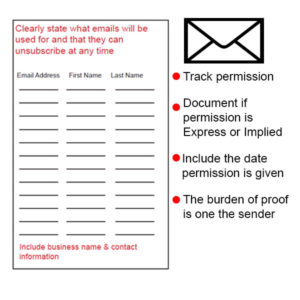
Off-line considerationsFB-CASL-reminder-for-SMall-Business-Week-2014

Not all email addresses are gathered on-line. Emails are collected at a point-of-sale, fundraisers, local markets, conferences and, networking events. If you use a sign-up sheet at an event, be sure your sheet clearly states that the subscriber is granting express permission to receive emails from you and that they can unsubscribe at any time. Your sign-up sheet must include your business name and relevant contact information.

You may include:

  • the types of emails – sales vs. informational
  • the frequency – daily, weekly, monthly etc.

Review Your Collection Methods

Now is a good time to review your lists. Most third-party email platforms should have provided the mechanisms with which to track activity on your contact lists. Whether you are collecting email addresses on-line or off-line, make sure you have the following elements:

  • Does your sign-up list have clear and obvious language asking for permission to be contacted in the future?
  • Does your sign-up sheet clearly identify you, your business or organization? This must include a valid mailing address and contact information.
  • Do you have a process with which to document consent?
  • Does your sign-up sheet indicate to subscribers that is a mechanism with which they can unsubscribe?

Don’t be Offended

People will unsubscribe from your newsletter. Don’t take this personally. People receive a lot of email in the run of a day and unsubscribing can reduce the clutter in their inbox. Your challenge is to provide educational, entertaining and engaging content your subscribers can use. Inform; don’t sell!

Who’s in Charge?

In case you are wondering who is responsible for enforcing the legislation, the oversight of CASL falls under the following governmental banners:

  • Industry Canada; Spectrum
  • Information Technologies and Telecommunications Sector (SITT)
  • Canada’s Office of Consumer Affairs (OCA).

I encourage you to visit fightspam.gc.ca to learn more.

Contact me if you would like a CASL Marketing Review.

Filed Under: Content

Next Page »

Receive tips and ideas to help you create content that will engage, educate, and entertain your audience.

Select list(s) to subscribe to


By submitting this form, you are consenting to receive marketing emails from: . You can revoke your consent to receive emails at any time by using the SafeUnsubscribe® link, found at the bottom of every email. Emails are serviced by Constant Contact

Join me on Facebook

Join me on Facebook

Blog Archives

  • March 2020
  • September 2018
  • April 2017
  • August 2016
  • July 2016
  • April 2016
  • March 2016
  • July 2015
  • June 2015
  • February 2015
  • January 2013

Search this site

Recent Posts

  • Storytelling in an Uncertain Time
  • Is Your Content Agile?
  • Emails with Benefits
  • Allow Me To Introduce Myself…
  • Are you compliant?

My Services

Email Marketing
Content Curation
Graphic Design

Contact Me

Call: 250-744-7680

Email: suelle@suellestewartcreative.com

Website Design by MAC5

SiteLock

Copyright ©2015 Suelle Stewart Creative - All rights reserved | Website Design by MAC5